Livelihood Assistance Restoring Hope and Economic Stability for a Family in Nangarhar Province
Background
In many rural areas of Afghanistan, limited employment opportunities and a lack of access to livelihood programs make it very difficult for vulnerable families to secure stable incomes. Many households depend on irregular daily labor and low-income activities that are often insufficient to cover their basic needs, leaving families in a constant struggle to provide food, clothing, and other essential necessities.
The Challenge
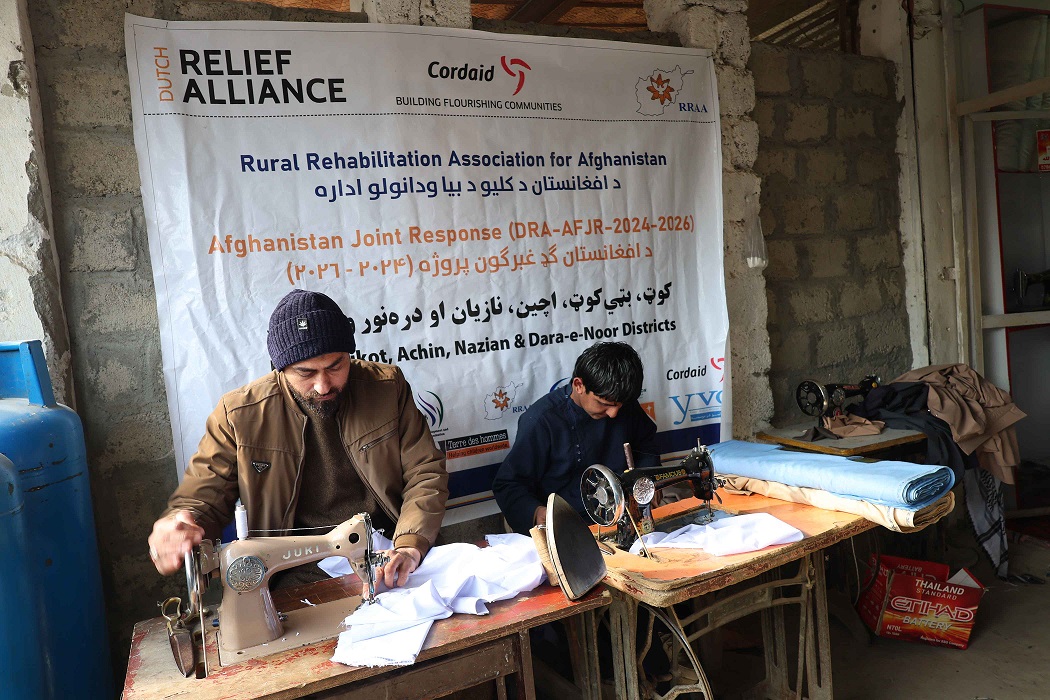
Among these households is Mohammad Aimal, a resident of Bati Kot District in Nangarhar province, who is the head of an eight-member household consisting of four men and four women. For years, his family lived under constant financial pressure due to a limited and unstable income. He worked as an apprentice tailor, earning only about 100 to 120 AFN per day. Although he had the necessary tailoring skills, he lacked the financial resources to purchase the proper equipment and materials to open his own shop, leaving him unable to increase his income or improve his family’s living conditions.
"Before receiving assistance, I worked as an apprentice tailor, earning about 100 to 120 AFN per day. I had the skills, but I did not have the financial ability to purchase the required tools and materials to open my own tailoring shop. Without those, it was impossible for me to move forward."
Support That Created a Path Toward Self-Reliance
A turning point came when Mohammad was selected to participate in a Livelihoods and Economic Recovery Program designed to support vulnerable households with income-generating opportunities. The project is implemented by the Rural Rehabilitation Association for Afghanistan (RRAA) and funded by DRA/Cordaid. As part of the intervention, Mohammad received a comprehensive Tailoring Kit to help him start his business.
The kit included:
A quality sewing machine with a table
Two rolls of quality men’s fabric
A clothes iron
A gas cylinder
Tailoring accessories and other essential materials
The Impact
With the help of this well-equipped kit, Mohammad successfully opened his own tailoring shop in his village—a dream he had held for years but was previously unable to achieve. Since opening the shop, his income has significantly improved. He is now able to provide for his family’s basic needs with much greater stability and dignity.
"This intervention changed everything for me. I no longer depend on unstable daily income. Owning my own shop and having a regular income makes me proud, and my family is doing much better now. Getting this support helped me start my own business and take care of my family with dignity."
Conclusion
Mohammad believes that livelihood support programs play a vital role in strengthening resilience and creating long-term economic stability for vulnerable families. Expressing his deep appreciation, he concluded: "I want to thank DRA-AFJR for their support, Cordaid for their leadership, and RRAA for implementing this project, which changed my life and gave my family a real chance for a better future."